Showing posts with label Typologies. Show all posts

Monday, October 26, 2009

Photographic Typologies: Chris Jordan

Chris Jordan recently updated his website with a new series entitled Midway: Message From The Gyre. In the statement for the work, he explains:

"These photographs of albatross chicks were made just a few weeks ago on Midway Atoll, a tiny stretch of sand and coral near the middle of the North Pacific. The nesting babies are fed bellies-full of plastic by their parents, who soar out over the vast polluted ocean collecting what looks to them like food to bring back to their young. On this diet of human trash, every year tens of thousands of albatross chicks die on Midway from starvation, toxicity, and choking.

To document this phenomenon as faithfully as possible, not a single piece of plastic in any of these photographs was moved, placed, manipulated, arranged, or altered in any way. These images depict the actual stomach contents of baby birds in one of the world's most remote marine sanctuaries, more than 2000 miles from the nearest continent."


From "Midway: Message From The Gyre"
© Chris Jordan


From "Midway: Message From The Gyre"
© Chris Jordan


From "Midway: Message From The Gyre"
© Chris Jordan


From "Midway: Message From The Gyre"
© Chris Jordan


From "Midway: Message From The Gyre"
© Chris Jordan

Saturday, August 1, 2009

Photographic Typologies: Stefan Ruiz

I discovered Stefan Ruiz's typology of rodeo queens over at Toxico Cultura the other day. On his website he writes:

"I went to Las Vegas for the Miss Rodeo USA contest. It was this week of events where at the end a winner is chosen to be kind of the representative for rodeo and cowboy culture, helping to sell agricultural products, things like that. The winner has to sign this agreement where she isn’t going to have a boyfriend for a year. What I liked about the contestants was that although they’re all clearly different people, they almost all had the same expression. They wore the same type of outfit, the same hair."


From "Rodeo Queens"
© Stefan Ruiz


From "Rodeo Queens"
© Stefan Ruiz


From "Rodeo Queens"
© Stefan Ruiz


From "Rodeo Queens"
© Stefan Ruiz


From "Rodeo Queens"
© Stefan Ruiz

Sunday, July 19, 2009

Photographic Typologies: Simon Ward

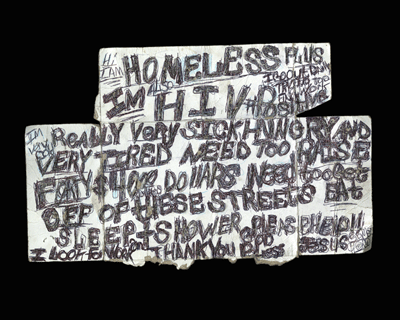
Simon Ward's typology of signs explores aspects of personality and individualism through an examination of handwritten marks. Each sign's penmanship possesses idiosyncrasies that point toward uniqueness of character. These images accentuate how much there truly is to learn about someone by inspecting the gestures and features that mark their writing.


Paul, 2007 (From "Signs")
© Simon Ward


2007 (From "Signs")
© Simon Ward


Chris, 2006 (From "Signs")
© Simon Ward


Dave, 2006 (From "Signs")
© Simon Ward


Nancy, 2006 (From "Signs")
© Simon Ward

Saturday, July 4, 2009

Photographic Typologies: Eric Tabuchi

French photographer Eric Tabuchi wrote me the other day to share the link to his website. His site consists largely of typological studies of various facets of the European landscape. I found this series of Road Signs, however, to be the most endearing and humorous of all of Tabuchi's numerous projects.


Sans Titre, 2005 (From "Road Signs")
© Eric Tabuchi


AVENTUE LAND, 2008 (From "Road Signs")
© Eric Tabuchi


Road Signs, 2005 (From "Road Signs")
© Eric Tabuchi


Blue Sharck, 2005 (From "Road Signs")
© Eric Tabuchi


Aquarium/Requins Vivants, 2007 (From "Road Signs")
© Eric Tabuchi

Saturday, May 9, 2009

Photographic Typologies: Caitlin Price

Soon-to-be Yale graduate Caitlin Price's images of sunbathers exist in a long line of tradition pioneered by people such as Joel Meyerowitz, Stephen Shore and Joel Sternfeld. Unlike her street photography, which positions itself more closely to diCorcia's emotionally ambiguous "indecisive moments," Price's mini-typology of sun tanners explore people as cultural symbols or totems that transmit more about a societal identity than a personal one.


All Images © Caitlin Price

Monday, April 20, 2009

Photographic Typologies: Peter Piller

In 2002, German photographer and archivist Peter Piller obtained over 20,000 aerial photographs from a bygone business venture that endeavored to sell homeowners images of their own houses. In the statement for the work, somewhat dryly titled Arial View Archive, Piller explains:

"The salesperson had used a ball-point pen to add some revealing notes to the back of the photographs: “Not interested in pictures”, “looks nicer from the ground”, “wife keen, but house too expensive”, “you’ll get half a moped for that”, “doing it himself” or simply: “deceased”, for instance.

After several archive inspections, I was led to the first collection themes and classification categories: “Sleeping Houses”, “Floral Objects” and “Person in front of House”. Whilst sifting, for the forth, fifth and sixth time, through 18 removal boxes packed with yellowing photos and negatives; I eventually discovered the material that now constitutes the content of this book."


All photographs from the series Arial View Archive

All Images © Peter Piller

Tuesday, April 7, 2009

Photographic Typologies: Jan Kempenaers

Belgian photographer Jan Kempenaers series Spomenik: The End of History depicts monuments erected by the communist regime in former Yugoslavia.


All photographs from the series Spomenik: The End of History

All Images © Jan Kempenaers

Thursday, December 11, 2008

Photographic Typologies: Jon Feinstein

Jon Feinstein e-mailed to to share some images from his wonderful project Fast Food, a typology which explores the fine line between temptation and repulsion in fast food culture. As Feinstein notes in his statement:

"Since the 1950's fast food has become so globalized that its icons are often as recognizable as popular historical figures—its image heavily branded into the public periphery. "Fast Food" is a typological exploration of the food on its own. Burgers, french fries, chicken nuggets and "specialty" sandwiches are presented on stark black backgrounds, isolated from their common context, without name recognition, nearly floating in space. Under austere, uniform lighting; stripped of logos, packaging and iconography, the food takes on a disgustingly ethereal and scientific quality. These images investigate the love/hate relationship that many Americans have with fast food and, like many other aspects of popular culture, its ability to be simultaneously seductive and repulsive."


From Top To Bottom:

8 Grams

29 Grams

11 Grams

13 Grams

42 Grams

All Images © Jon Feinstein

Tuesday, December 9, 2008

Photographic Typologies: Verner Soler

I discovered Verner Soler's work in the new issue of Fraction Magazine as part of their Typologies: A Group Show. The images below exist as part of his series Heads, a typological examination of extended family members in Switzerland. In the statement for this work, Soler asserts:

"I try and visit my family once a year, and every time I brace myself for the shock of seeing them age in yearly increments. Seeing my parents age this way especially, has been a painful experience as it is an unmistakable reminder of their (our) mortality. This realization was the impetus for making a definitive record of them that will endure.

The ensuing typology includes over seventy relatives spanning three generations so far. Their faces are photographed straight on, from each side, and under the same exact lighting conditions, achieving an objective comparison of facial features."


All photographs from the series Heads

All Images © Verner Soler

Monday, November 17, 2008

Photographic Typologies: Robert Voit

I found Robert Voit's series New Trees via From This Moment about a week ago. His examination of cell phone tower trees, often brazenly and aggressively situated, ironically explores yet another aesthetic addition to the already inundated social landscape. As Christoph Schaden affirms:

"His pictorial inventory, a work-in-progress since 2003, of mobile phone masts in the guise of artificial trees erected in real space in the U.S., Great Britain, South Africa, Korea, Italy and Portugal pays superficial tribute to a diffuse creative will driven by a basic desire for conciliation. To visually compensate for the dangers of electro-smog, mobile phone masts are given plastic “magic hoods” which simulate nature so that they then appear in the landscape as idealized forms of vegetation. The broad range of camouflage outfits includes deciduous trees and conifers, pines, palms and huge cacti. A lucrative manufacturing industry specializing in these artificial trees has emerged with considerable future potential; currently it is gaining a foothold on the European continent."


All photographs from the series New Trees

All Images © Robert Voit